

At the North Pole, the Greenland ice sheet is melting inexorably as a result of accelerating global warming. Although scientists expect it to melt completely, projections remain uncertain, as future instabilities are difficult to predict. A specialist in marine geosciences and a PhD student at the Geo-Ocean laboratory at the Ifremer site in Brest, Clara Lery is attempting to identify and replicate the major instabilities of this ice sheet during past major climate upheavals. Her aim is to simulate its various behaviours based on several climate scenarios, in order to assess its potential responses to variations in future climate conditions.
By Carole Saout-Grit
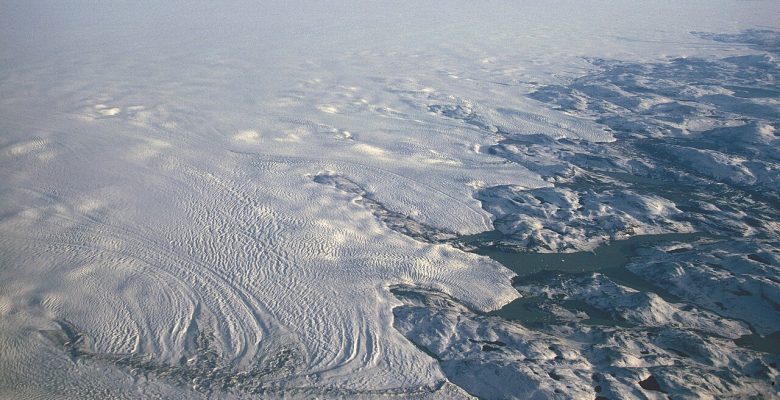
Cover photo: Aerial view of the ice sheet in eastern Greenland ©️ Hannes Grobe 2007
An autonomous Danish territory situated between the North Atlantic and the Arctic Ocean, Greenland stretches between 60°N and 84°N over a land area of 2.2 million square kilometres. More than 80% of its territory is covered by an ice sheet, known as the Greenland Ice Sheet or GrIS, which plays a key role in the climate dynamics of the Northern Hemisphere.
While scientists expect the melting of the polar ice caps due to global warming to cause sea levels to rise by between 0.6 m and 1.1 m by 2100, this estimate is likely to be an underestimate. Palaeoscience suggests that major instabilities in marine ice margins (such as accelerated melting or large-scale instabilities), which have not been observed in recent decades, could occur in the near future. Whilst it remains difficult to predict how the Greenland ice sheet will behave in the face of future instabilities, it is crucial to identify major past climate upheavals to better understand how it may have responded to them.
The dynamics of the Scoresby Sund fjords under the microscope
During the major climatic upheavals of the last 25,000 years, corresponding to the Last Glacial Maximum, the Greenland Ice Sheet (GrIS) experienced significant instability. At Scoresby Sund, a vast fjord system located in central-eastern Greenland, this evolution manifested itself over this period as a glacial retreat of approximately 300 km, the history of which is preserved in the sediments. Two fjords, Scoresby Sund at 70°N and Kaiser Franz Joseph Fjord at 73°N, together form the outlet of a glacial catchment area of nearly 160,000 km² in eastern Greenland. Representing almost 10% of the Greenland Ice Sheet (GrIS), they are prime targets for the study of glacial paleo-instabilities.
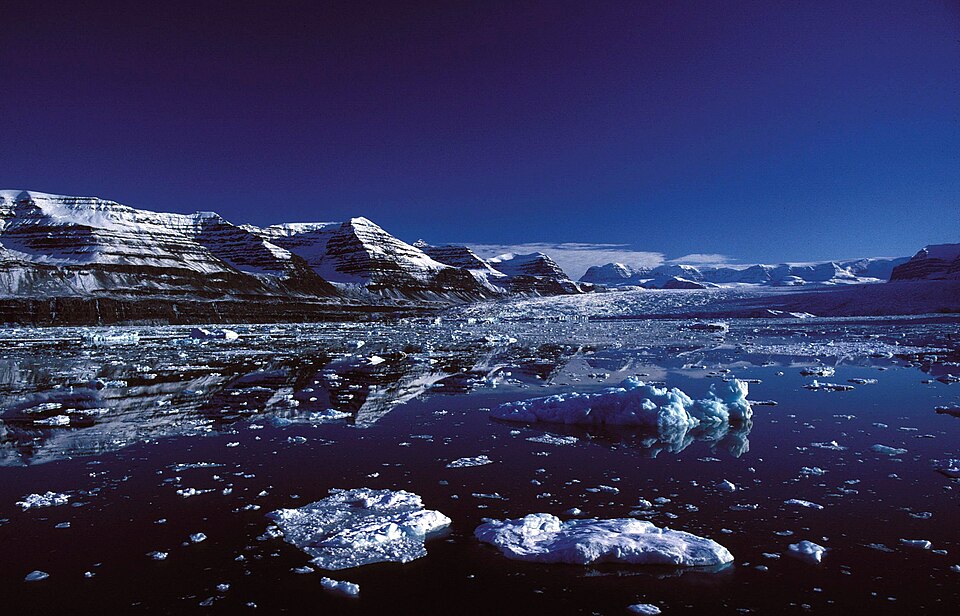
Scoresby Sund, Greenland ©️ Hannes Grobe, 2010
Specialising in marine geosciences and passionate about glacier dynamics, Clara Lery focuses specifically on this area of Scoresby Sund, known as ‘Kangertittivaq’ by the Greenlanders.
A PhD student since 2024 at the Ifremer site in Brest, her aim is to combine marine geology and 3D glaciological simulations to identify and study past instabilities of the Greenland Ice Sheet (GrIS) in this area, focusing on the period of the last 15,000 years during which the ice sheet transitioned from a ‘marine’ configuration, with ice extending far out into the ocean, to a ‘terrestrial’ configuration.
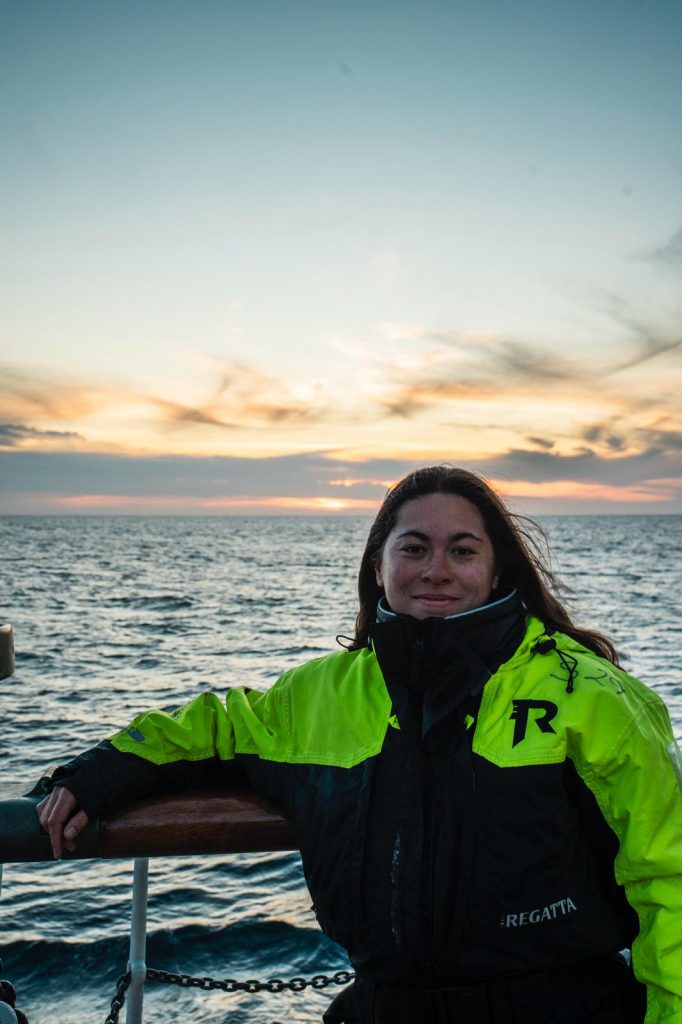
Clara Lery on the One Ocean Expedition mission in the Arctic Ocean, in partnership with the University of Tromsø ©️ Vincent Denarié
An innovative multidisciplinary approach combining data and numerical modelling
Clara’s primary objective is to reconstruct the glacial dynamics and instabilities of the eastern margin of the Greenland Ice Sheet (GrIS) during its post-glacial and Holocene retreat, using a marine geology approach that combines sedimentology and stratigraphy, mineralogy, and elemental and isotopic geochemistry. This work will be based on sediment cores collected in Scoresby Sund between 70°N and 75°N.
In a second phase, a modelling component using the GRISLI (Grenoble Ice Sheet and Land Ice) model is planned, in order to translate these glacial dynamics (in terms of amplitude, duration, velocity and temperature) into regional glaciological parameters through 3D numerical simulations. This modelling component will enable the simulation of different behaviours of the Greenland ice sheet based on several climate scenarios, in order to assess its potential responses to variations in future climate conditions.
In a third phase, the aim will be to identify the direct (such as temperatures, insolation and CO₂) and indirect (such as isostatic rebound) climate forcings that explain this glacial dynamics, in order to better understand the factors influencing variations in the Greenland ice sheet.
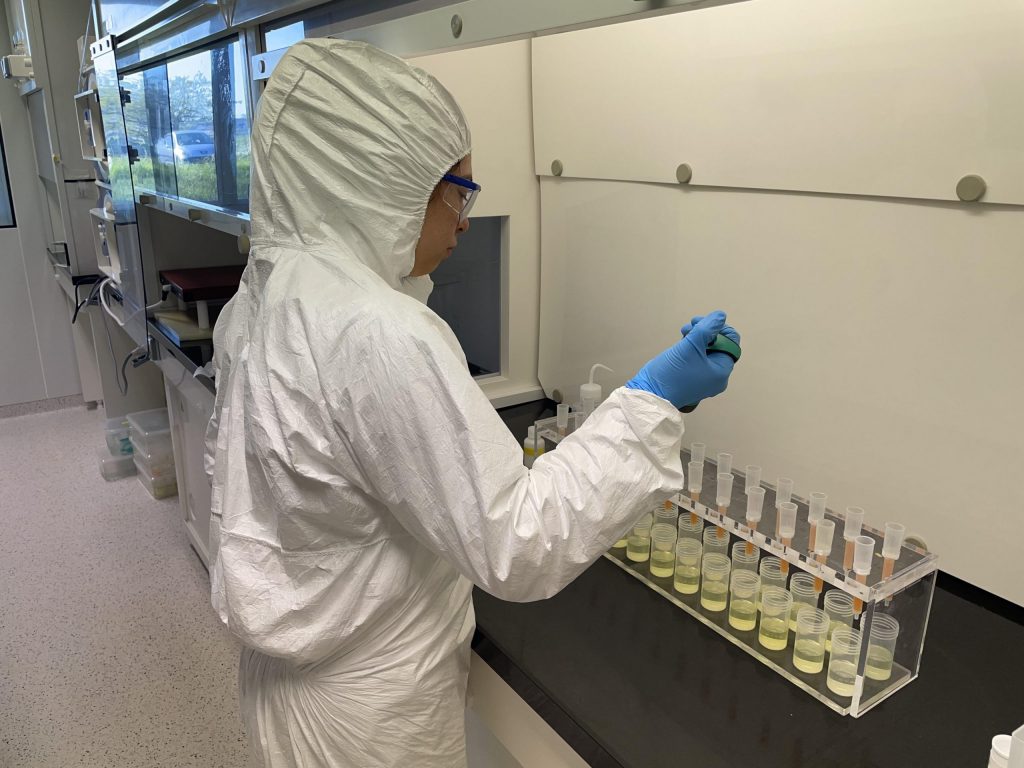
Clara Lery handling sediments in a clean room ©️ C/Lery
Clara is based at the Geo-Ocean laboratory (a joint CNRS – Ifremer – UBO – UBS research unit) at the Ifremer site in Brest, as well as at the LSCE(Laboratory of Climate and Environmental Sciences, a joint CEA -CNRS- UVSQ research unit) at the Institut Pierre-Simon Laplace (IPSL) in Paris for the numerical modelling aspect. Clara also benefits from collaborations with German teams at the Alfred Wegener Institute (AWI) and British teams at Loughborough University.
Funded by the Ocean and Climate Priority Research Programme, his PhD research is supervised by Stephan Jorry (Ifremer) and co-supervised by Samuel Toucanne (Ifremer) and Aurélien Quiquet (LSCE). This research forms part of the PATATRAS project (PAléo-insTAbilité des calottes polaires à la TRAnsition terre-mer : une approche données/modèleS). Whilst the initial results are already very promising, the full of this work should provide a better understanding of glacial instabilities, ultimately enabling us to improve sea-level rise projections, on which our adaptation to ongoing climate change depends.
Three questions for Clara Lery
Why did you decide to do a PhD in marine sciences?
Geology is a science that allows us to study past environments and climates, as well as events that are no longer visible today and some of which occurred billions of years ago. It’s absolutely fascinating! When you add the marine component – which is just as fascinating and has been present practically since the beginning of our planet’s existence – you realise just how interconnected all terrestrial systems are. That’s why I felt that studying marine sciences was both more complex and even more rewarding.
What made you want to apply for this thesis topic? What were your motivations?
I was fascinated from a very young age by glacier dynamics and their role in the climate system. They are such sensitive yet powerful systems! They can disappear and reform over the course of a few thousand years, all whilst having a colossal impact on their surroundings (ocean currents, temperatures, sea-level rise…). That’s why I was quite disappointed and surprised that very little was said about them during my undergraduate studies in marine geosciences. So I took the initiative and undertook internships in the field of ice-rock interactions with the aim of turning this into a thesis. I’ve noticed that glaciers are extensively studied and yet still poorly understood. It’s to make my own small contribution to this body of knowledge that I wanted to write a thesis on this subject.
How do you envisage your future after this thesis?
During my thesis, I’ve been heavily involved in science outreach projects. I’ve had the chance to visit a care home, leisure centres and schools. In particular, we’re putting on a play as part of the PPR Arts-Sciences funding scheme. I realised that my work really came to life when I shared it with people who don’t have access to this knowledge. The act of communicating, explaining and making these subjects accessible has had a profound impact on me. It was then that I realised that science communication and popularisation were probably my calling. That is why I would like to move into teaching or science communication.
Reference : Clara Lery, « Paleo-instabilities of the polar ice caps at the land-sea transition: a data/model approach (PATATRAS) », thesis 2024-2027
Contact : clara.lery@ifremer.fr