

The ocean, which contains around 50 times more carbon than the atmosphere, plays a vital role in regulating our planet’s climate by acting as a key factor in controlling atmospheric CO2. Numerous processes are at work to make the ocean a true natural carbon sink capable of absorbing, transferring and then storing this atmospheric CO2 in the deep ocean. At the Research Institute for Development within the Mediterranean Institute of Oceanography in Marseille (France), Ambroise Delisée is studying the tropical ocean’s capacity to sequester CO2 biologically through diazotrophs. His PhD research, carried out as part of the European ERC HOPE project and funded for three years by the Priority Research Programme ‘Ocean and Climate’, aims ultimately to improve predictions regarding the ocean’s current and future role in mitigating climate change.
by Carole Saout-Grit
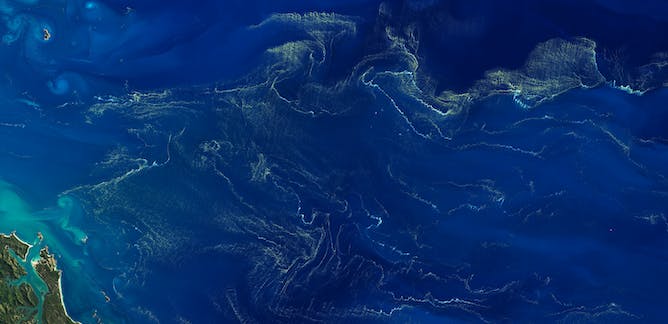
Cover photo: Bloom of diazotrophs (Trichodesmium) in the Coral Sea, captured on 1 September 2019 by the Landsat 8 satellite. ©️Joshua Stevens/NASA
Since the start of the industrial era, the ocean has absorbed nearly 25% of our CO2 emissions, making it a key factor in mitigating climate change. The ocean absorbs atmospheric CO2 naturally in the surface layer through chemical dissolution in seawater. The transfer of carbon from the surface to the deep ocean then takes place either through ocean currents, via a so-called ‘physical’ carbon pump, or through marine life, via a so-called ‘biological’ carbon pump. The intensity of this biological pump depends heavily on the activity of marine life, and in particular on the vitality of phytoplankton, which forms the basis of the food chain.
Diazotrophs: the natural fertilisers of the tropical oceans
In the sunlit layer of the ocean, much of the CO2 is taken up by phytoplankton. These marine micro-organisms, invisible to the naked eye and capable of photosynthesis, convert dissolved CO2 into a form of organic carbon. This process forms the basis of the ocean’s biological carbon pump and the transfer of CO2 from the surface to the deepest depths. However, whilst it requires light to carry out photosynthesis, phytoplankton also needs nitrogen, a nutrient essential for its growth. However, nitrogen is often in short supply in the ocean: coastal areas receive nitrogen via rivers or upwelling of deep water rich in it, but most of the open ocean does not benefit from these sources.
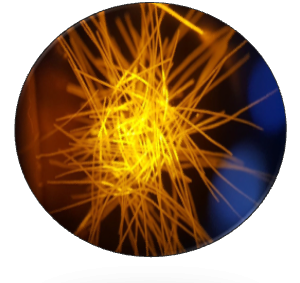
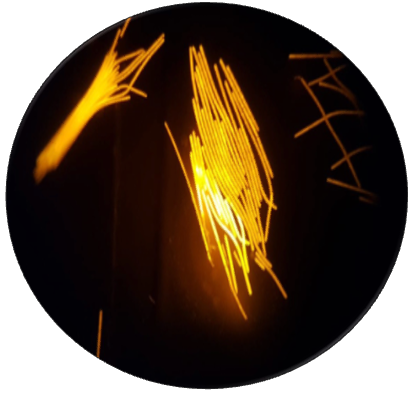
Diazotrophic Trichodesmium spp. Viewed under an epifluorescence microscope. © S. Bonnet
The tropical ocean in particular, with its warm surface waters and limited vertical mixing with deeper waters, is often described as a nitrogen-poor ‘oceanic desert’. Fortunately, other tiny creatures exist to make up for this shortfall: diazotrophs. As their name suggests, diazotrophs are marine microorganisms capable of fixing atmospheric nitrogen and converting it into a form of nitrogen available to phytoplankton. They naturally fertilise the tropical oceans and strongly support phytoplankton growth, thereby significantly activating the biological carbon pump.
A highly dynamic process in the tropical ocean
The tropical ocean, located between 30°N and 30°S, accounts for nearly 50% of the world’s oceans. In this region, diazotrophs play a major role, particularly during the southern summer, between November and April. During this period, these microorganisms generate spectacular blooms and act as a natural fertiliser, stimulating the food chain and the carbon pump.
However, the intensity of this biological carbon pump in the tropical ocean is still poorly understood. The biological and physical pathways enabling the export of diazotrophs to the deep ocean are numerous and complex; quantifying them and identifying their variability factors is very difficult to achieve using current ocean measurement methods.
As part of the ERC HOPE project led by the IRD (French National Research Institute for Sustainable Development, scientific lead Sophie Bonnet) at the Mediterranean Institute of Oceanography (MIO) in Marseille, Ambroise Delisée is investigating this issue. He is leading a three-year programme of experiments and scientific research to attempt to decipher the mechanisms at work in one of the pathways by which carbon is transported to the deep ocean via the biological pump: a direct pathway involving the diazotrophs themselves, which has only recently been identified and is still poorly understood.
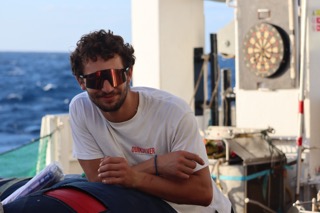
©️ Ambroise Delisée
An innovative multidisciplinary approach
At the interface between microbiology, geochemistry, physics and innovative sensor technology, Ambroise Delisée’s research aims to advance our understanding of the intensity of the biological carbon pump driven by diazotrophs in the tropical ocean through an innovative multidisciplinary approach. It is structured around three scientific objectives:
- To identify the sinking rates of diazotroph-derived particles and the factors controlling them, by analysing how different diazotrophs aggregate, sink and are remineralised in the ocean. To this end, Ambroise uses a 6-metre-high automated experimental water column specially designed for this project.
- To understand how the surface ecosystem shapes the quality and quantity of this export, and how environmental factors control the export of diazotrophs at the surface. To this end, an autonomous, multi-instrumented profiling buoy (‘Smart buoy’) is deployed, alongside a grid of fixed moorings.
- To measure the contribution of oceanic vertical velocities and the role of physical processes in the additional transport of carbon to the deep ocean. To this end, vertical velocities are measured in the ocean through the simultaneous analysis of small-scale physical structures (eddies and fronts) and biogeochemical measurements collected during oceanographic expeditions conducted overseas, particularly in the South Pacific.
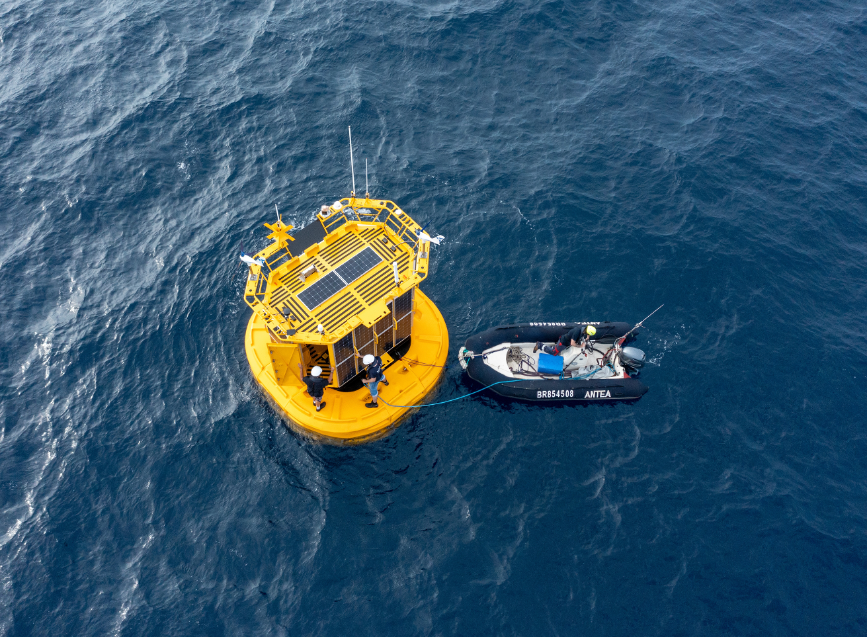
Deployment of an autonomous, multi-instrumented profiling buoy (‘Smart buoy’) – ERC HOPE Project
A PhD thesis undertaken as part of a major international programme
Funded for the period 2024–2027 by the PPR Ocean and Climate programme, Ambroise Delisée’s PhD thesis is supervised by Sophie Bonnet (Research Director) and Anne Petrenko (Senior Lecturer) at the MIO laboratory of Aix-Marseille University. More broadly, this work forms part of the HOPE project funded by the European Research Council (ERC) and led since 2024 by Sophie Bonnet and the IRD in Nouméa, New Caledonia.
The HOPE project aims to study the capacity of tropical oceans to sequester CO2 and has enabled the deployment in the South Pacific of a unique, very large smart instrumented buoy. With a diameter of five metres and equipped with numerous innovative sensors, this buoy enables simultaneous sampling of the ocean at the surface and at depth every four hours for four years, with data transmitted in real time to oceanographers on land.
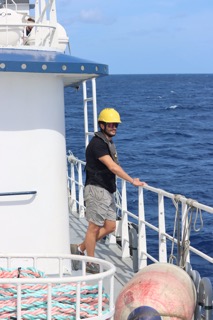
Ambroise aboard an oceanographic vessel©️A.Delisée
Ambroise carried out a great deal of work during this first year of his PhD, including four sea campaigns and regular visits to the HOPE buoy. The seasonal nature of diazotrophic blooms led Ambroise to carry out numerous field experiments and to temporarily suspend data processing. Although many results are still being analysed, all aspects of the research have been initiated and point to numerous research opportunities over the next two years.
Three questions to Ambroise Delisée
Why did you decide to do a PhD in marine science?
The ocean has always been a guiding force for me. The further I progressed in my studies, the more I realised that it is a key component of the global system, capable of absorbing and storing a significant proportion of carbon. I wanted to write a thesis in marine science to get to the heart of these processes, combining fieldwork, experiments and data analysis, and producing useful results to better anticipate climate change.
What made you want to apply for this thesis topic? What were your motivations?
I was absolutely keen to work on the global biological carbon pump, because it is one of the key mechanisms that directly links the ocean to the climate. I was also drawn to the subject because of its ‘process’ aspect: understanding what controls carbon export, at what scales, and with what uncertainties. Finally, the project’s approach was exactly what I wanted to do.
How do you envisage your future after completing your thesis?
After completing my PhD, I would like to undertake postdoctoral research that continues to focus on the biological carbon pump, ideally by scaling up the project further. In the longer term, my aim is to become a researcher, so that I can continue to develop projects on these issues and contribute to climate and ocean research.
Reference : Ambroise Delisée, « DIAZO-PUMP : The role of diazotrophs in the biological carbon pump: deciphering biological (gravitational pump) and physical (vertical velocities) export pathways using a combination of innovative methods and sensors operating at high frequency », phD 2024-2027
Contact : ambroise.delisee@mio.osupytheas.fr