

Although the ocean has absorbed more than 25% of the excess carbon dioxide (CO₂) in the atmosphere since the industrial era, this increase has had a significant impact on water quality, with waters becoming increasingly acidic and oxygen-depleted as a result of this excessive absorption. In coastal areas in particular, shellfish farmers are on the front line in trying to adapt their activities to these often unpredictable changes in water quality. Against this backdrop, scientist Hugo Herteman-Billottet is embarking on a PhD at Ifremer in Brest, funded by the Priority Research Programme (PPR) ‘Ocean and Climate’, and aims to assess the effects of introducing macroalgae into certain coastal shellfish ecosystems. By strengthening the ocean’s carbon sink, the aim is to make the French shellfish industry resilient to global warming.
by Carole Saout-Grit
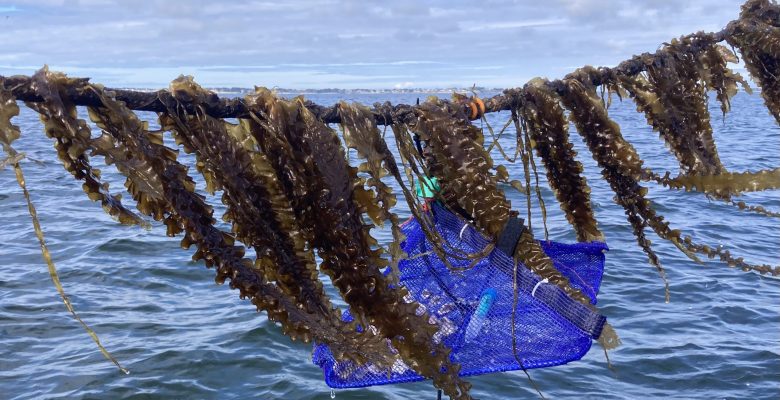
Cover photo: establishment of macroalgae cultures ©️ H. Herteman-Billottet
Covering more than 70% of the Earth’s surface, the ocean is the planet’s only fluid envelope in direct contact with the atmosphere. Its waters, particularly when cold, have a very high capacity to absorb, then dilute and store deep within the ocean the CO₂present in the air. Macroalgae, like phytoplankton and other marine algae, have the ability to absorb atmosphericCO₂in the sunlit layer of the ocean’s surface and release oxygen during photosynthesis.
Shellfish farmers facing ocean acidification
As a result of accelerating global warming, the ocean’s increasing absorption of atmosphericCO₂not only leads to a drop in its pH and an increase in its acidity, but also to a reduction in the availability of dissolved oxygen. These physico-chemical imbalances are causing significant degradation of coastal areas, which are shallower and richer in nutrients than the open ocean but particularly vulnerable to these rapid changes.
In these coastal regions, the French shellfish industry is particularly exposed to these environmental pressures, which may lead in the long term to reduced yields, just as the already recurrent epizootics (equivalent to epidemics in humans) are undermining businesses. Shellfish farmers strive to ensure the harmonious growth of oysters at all stages of their development, under water quality conditions that are sometimes unpredictable.
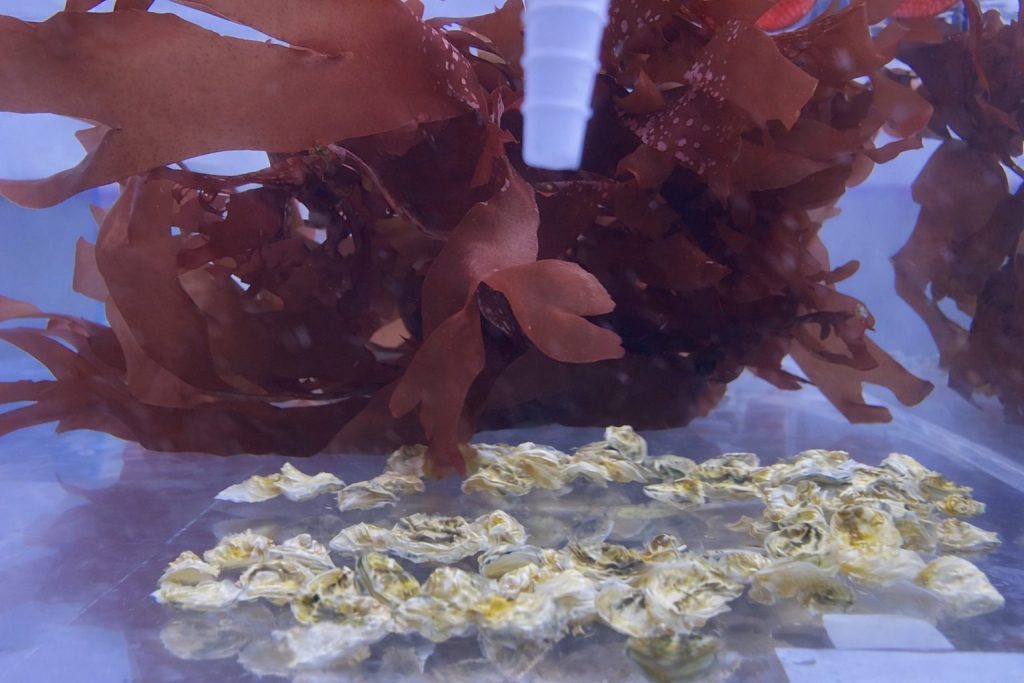
Co-culture de macroalgues et huîtres
Co-cultivation of macroalgae and oysters
In order to combat the acidification and deoxygenation of coastal waters at a local level, scientists, in collaboration with the French shellfish farming community, are testing the idea of seeding coastal shellfish ecosystems with macroalgae. This nature-based solution could help boost ocean carbon sequestration, provided there is a sufficient supply of nutrients under suitable environmental conditions.
Revegetating coastal ecosystems to make them resilient
This technique of greening coastal shellfish ecosystems with macroalgae appears promising. Very recent laboratory studies have shown that eelgrass beds and macroalgae can mitigate the harmful effects of excess CO₂on calcifying organisms. The co-cultivation of macroalgae and shellfish has also been practised in many Asian countries for decades, demonstrating its effectiveness.
However, this nature-based solution raises questions about the compatibility of local algal species with farmed shellfish. Large-scale intensive macroalgae farming can lead to increased nutrient consumption and limit light penetration, thereby hindering phytoplankton production and shellfish growth. It may also influence, positively or negatively, the risk of disease when macroalgae and shellfish coexist in the same space.
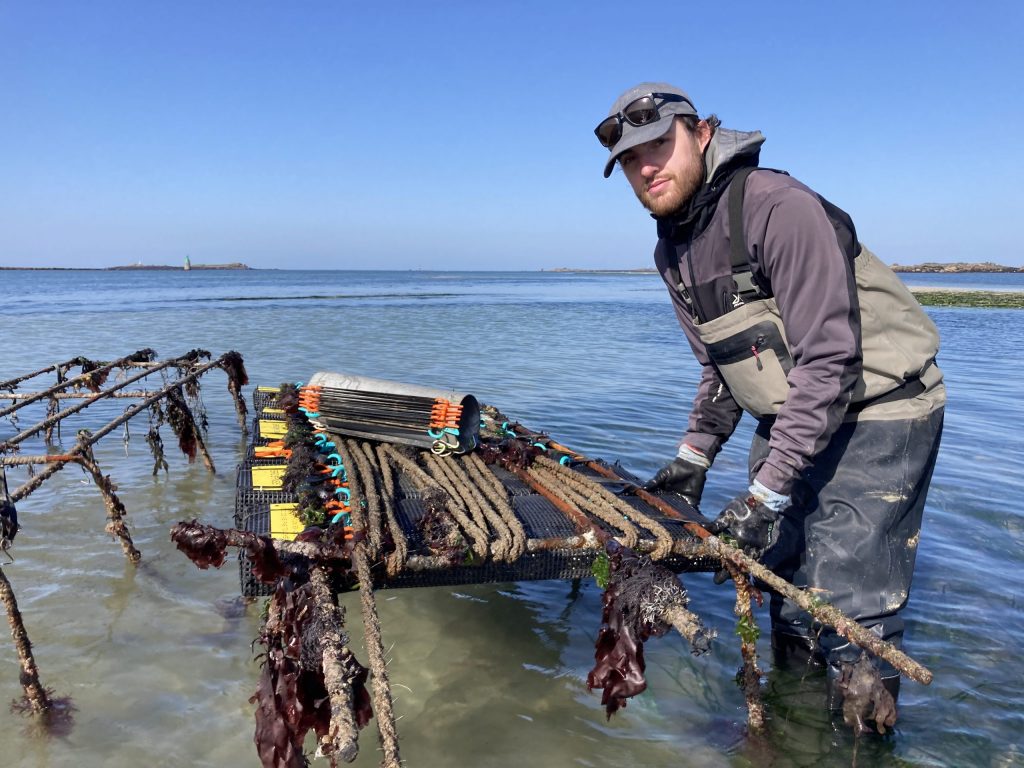
Hugo Herteman-Billottet surveying a macroalgae structure within a shellfish farm
Working in collaboration with scientific teams, the French shellfish industry is seeking natural solutions to ensure the long-term survival and productivity of its operations despite environmental changes. The co-cultivation of macroalgae with shellfish appears promising for enhancing the resilience of shellfish farming businesses in the face of climate change.
Observing, experimenting and modelling: an original and innovative approach
At the Ifremer centre in Brest, Hugo Herteman-Billottet is investigating this possibility. Over a three-year period, using an interdisciplinary approach combining biology, ocean physics and marine chemistry, his PhD research aims to combine field observations, laboratory experiments and modelling of the coastal shellfish farming ecosystem, to assess the effects of macroalgae on the physico-chemical parameters of seawater and on shellfish in co-culture.
This PhD research will draw on the first large-scale co-culture trials conducted in the Bay of Quiberon in Brittany, in partnership with the French shellfish industry. The Regional Shellfish Farming Committee of Southern Brittany, in partnership with Ifremer and the Centre for Algae Studies and Development, is developing the first large-scale co-culture trials in France on its concession in Quiberon Bay through the PECORINO project (Experimental Platform for CO-culture and INnovative techniques).
Quiberon Bay is regularly exposed to sporadic episodes of extreme acidification in summer, and the introduction of macroalgae may be beneficial for shellfish. However, concentrations of nutrients and phytoplankton have been declining over the past fifteen years, meaning that the addition of macroalgae could compete with phytoplankton for nutrients and hinder the growth of shellfish, a point that remains to be investigated.
At this experimental site, Hugo is initially setting up a spatially-based monitoring programme of chemical and biological parameters across some forty sites spread across the co-culture zone of Quiberon Bay and outside this zone. Each variable is mapped using geostatistical methods to visualise the effects of macroalgae, and each site will be sampled four times a year, in each season, for two years between January 2025 and January 2027.
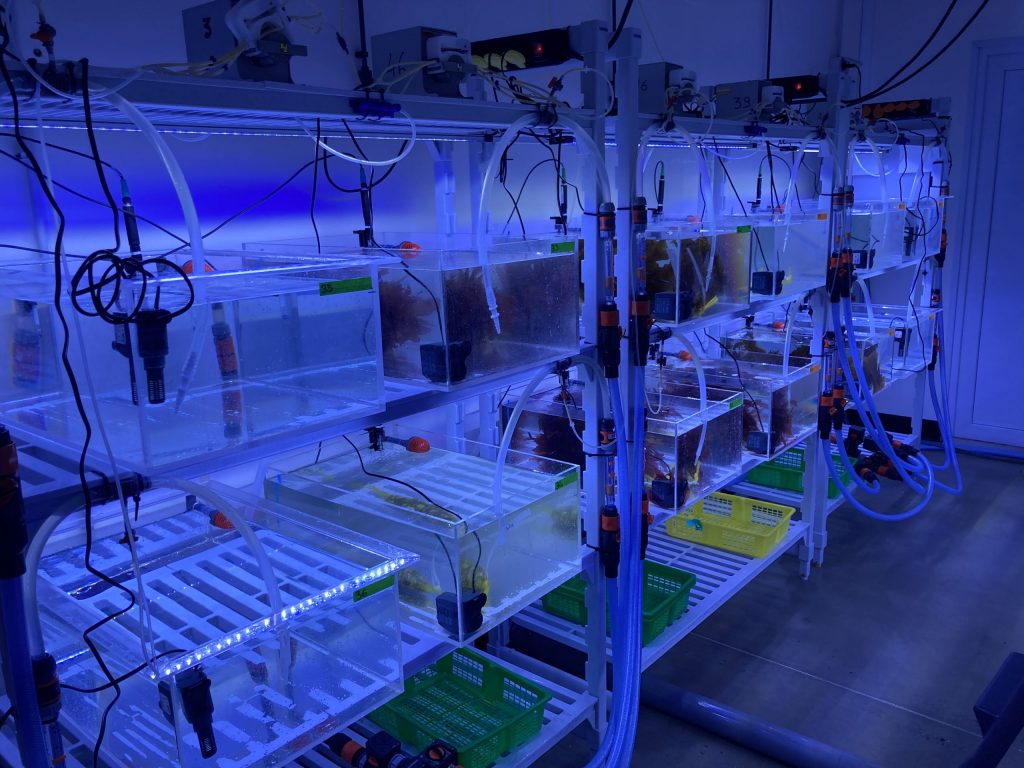
Laboratory experiments on juvenile oysters placed in various physico-chemical conditions
In a second phase, Hugo plans to conduct laboratory experiments at the Ifremer site in Argenton to assess the effect of different species of algae on the physico-chemical parameters of the water, following the day/night cycle. For example, he plans to expose juvenile oysters to future acidification conditions estimated by the IPCC, with or without macroalgae for one month, and under ambient conditions (control). The aim is to monitor the growth, survival and health of the oysters throughout the experiment and to assess the influence of each species of algae on their health.
Finally, a numerical modelling component will examine the effect of macroalgae cultivation scenarios on environmental parameters using a three-dimensional ecosystem model already employed to simulate the interannual variability in the occurrence of phytoplankton blooms. An initial configuration of the model will be set up to simulate a recent period without – and then with – macroalgae. Once validated, this model will subsequently enable the simulation of scenarios involving the intensification of macroalgae cultivation and the assessment of their impacts on the ecosystem and shellfish.
Future potential
Hugo’s research is co-supervised by Fabrice Pernet (UMR LEMAR) and Martin Plus (DYNECO Laboratory, Ifremer Brest). They are funded by the PPR Ocean and Climate programme as part of one of its major challenges aimed at evaluating alternative and innovative strategies for the sustainable use of biological resources, developing the knowledge needed to support aquaculture compatible with sustainable development goals, whilst anticipating ecosystem resilience.
This project constitutes the first impact study of the revegetation of a coastal ecosystem, a CO₂ capture technique that could be deployed on a large scale to increase the capacity of oceanic carbon sinks, and locally to strengthen the resilience of shellfish farming in the face of climate change. Whilst it has attracted keen interest from stakeholders, its initial findings also hold significant future potential for the French shellfish farming sector, which has been weakened by the multiple consequences of global warming.
Three questions for Hugo Herteman-Billottet
Why did you decide to do a PhD in marine sciences?
I’ve always loved the diversity found in the ocean, especially at low tide when it feels as though a whole new world is revealed for a few hours. As for the scientific side, I think it was my curiosity about species and their way of life that motivated me to pursue research. I completed a Master’s in ecology and wanted to add an applied dimension to it, which this PhD allowed me to do. I find marine biology to be a diverse field, where it’s possible to conduct research across many different areas using various complementary approaches, which is truly enriching and enables us to tackle problems with a wide range of tools.
What made you want to apply for this thesis topic? What were your motivations?
There are two main reasons why I wanted to get involved in this project. The first is the practical aspect of the subject, as I often work with professionals to find solutions to current problems. The aim of this project is to ensure the long-term viability of the industry in the face of climate change and to enable the sustainable, high-quality production of shellfish. The second reason is the diversity of approaches used, combining modelling, laboratory experiments and field monitoring – which complement one another and really allow me to gain experience and versatility.
How do you envisage your future after this PhD?
I’d like to continue in research, perhaps focusing my career more on teaching. Once I’ve completed my PhD, I plan to pursue a postdoc or a position as a research assistant. Ideally, I’d like to maintain this close connection with professionals (in aquaculture or fisheries) and retain the applied aspect of my research, even when working on topics other than aquaculture.
Reference: Hugo Herteman-Billottet, ‘Observation, experimentation and modelling of the vegetation of shellfish ecosystems by macroalgae: towards climate resilience’, PhD thesis 2024–2027
Contact : hugo.herteman.billottet@ifremer.fr