

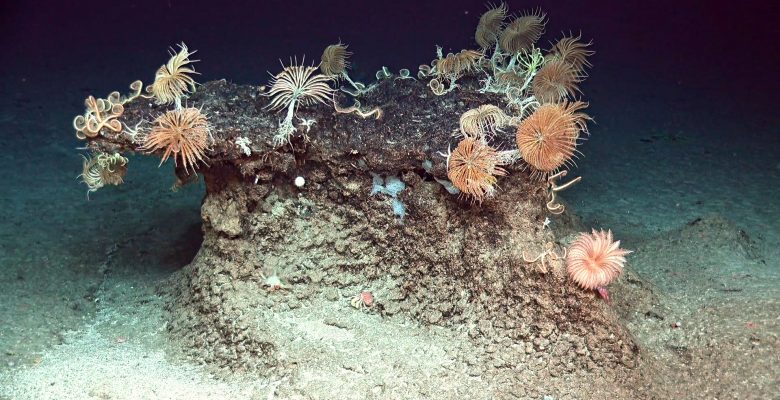
Rising several hundred metres above the ocean floor and found in every ocean on the planet, seamounts are incredibly rich in biodiversity. Their geological composition, geometry and geographical location make these structures exceptional oases of life. Félix Navarro, currently a PhD student at the Biology, Interactions and Adaptations of Organisms in Extreme Environments laboratory (UMR BEEP) at the Ifremer site in Brest, is exploring the close links between the heterogeneity of these seamounts and the distribution or composition of the marine benthic fauna they harbour.
by Carole Saout-Grit
Cover photo: Image of seamounts captured during the KANADEEP 2 campaign ©️ Ifremer – MNHN
Seamounts are isolated topographical features on the seabed. Rising sometimes several hundred or even thousands of metres above the ocean floor, they are scattered across the world’s seabed. Depending on their geological history, these features take on varied forms and are composed of very different rocks, sometimes covered by thick layers of ancient sediments.
By rising up in the middle of the ocean in this way, these mountains alter ocean currents. They can force nutrient-rich deep water to rise towards the surface through ‘upwelling’ currents. They are also the site of clashes between powerful underwater currents, leading to a unique sedimentation environment.
Over time, the rock, exposed and battered by the waves, becomes covered with a fascinating metallic crust, rich in coveted metals such as iron, manganese, nickel and cobalt. All these natural phenomena sculpt spectacular and incredibly varied underwater landscapes.
A little-known yet already highly prized underwater world
This great diversity of rocky terrain creates a multitude of habitats, attracting exceptional wildlife. The bare rock, bathed by nutrient-rich currents, provides an ideal environment for the ocean’s ‘filter feeders’: sponges, cold-water corals and distant cousins of starfish (crinoids and ophiuroids). As they grow, these organisms themselves form veritable underwater forests that serve as a refuge for many other species, including fish and crustaceans.
But these oases of life are fragile, and whilst deep-sea fishing has already had a significant impact on some of these ecosystems, the emergence of mining operations targeting these famous metal crusts – which are particularly abundant on the slopes of seamounts – poses a growing threat to their future.

Image of seamounts captured during the KANADEEP 2 campaign ©️ Ifremer – MNHN
Although these seamounts are regarded as veritable islands of biodiversity, much remains unknown about how these unique ecosystems function. From one seamount to another, and even from one flank to another of the same seamount, the landscapes and inhabitants often display remarkable diversity.
Increasing the number of observations and refining their accuracy is essential to better understand the exact link between rock type, topography and fauna. This issue, now of major importance, should in particular enable us to anticipate and limit the impacts of potential mining projects.
New Caledonia, a key site for research into seamounts
It is against this backdrop that Félix Navarro, an Ifremer PhD student in Brest, is studying the links between the characteristics of a seamount and the diversity of the habitat it supports, at a study site that remains largely unspoilt: New Caledonia.
Due to its complex geological history, this region features a wide variety of seabeds, home to around a hundred such seamounts. At the same time, the entire surrounding maritime area is protected by the Coral Sea Natural Park. Deep-sea trawling is strictly prohibited there, and a moratorium bans all mining projects. In this context, New Caledonia serves as an exceptional natural laboratory, enabling the combination of experiments, observations and analyses.
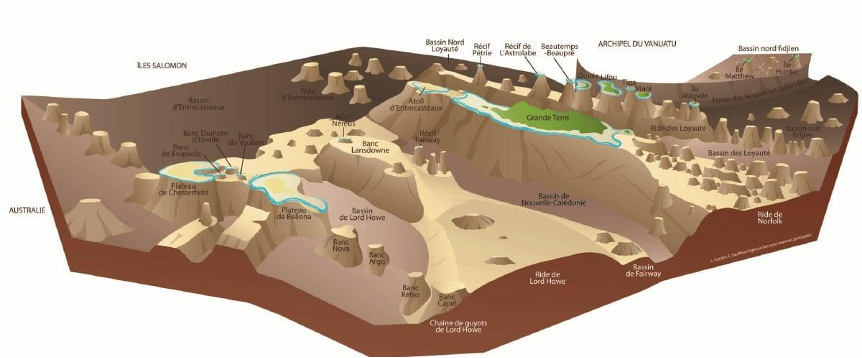
Coral Sea Natural Park, bathymetric profile and view of the seabed from east to west ©️ Catherine Geoffray, Lionel Gardes – Agency for Marine Protected Areas.
A deep-sea fauna exploration programme, known as Tropical Deep-Sea Benthos and led by the French National Research Institute for Sustainable Development (IRD) and the National Museum of Natural History (MNHN), has enabled numerous expeditions to be carried out in this part of the world.
In 2019, the KANADEEP 2 expedition explored three seamounts: Stylaster, Munida and Mount D, all located south-east of Grande Terre. During this mission, a wealth of valuable data was collected (samples taken using marine trawls, measurements using multibeam echo sounders, etc.). In addition, several dives using a remotely operated vehicle (ROV) enabled the slopes and summits of these three seamounts to be explored and regular photographs of the seabed to be taken, allowing for the study of the fauna and the nature of the substrates present.
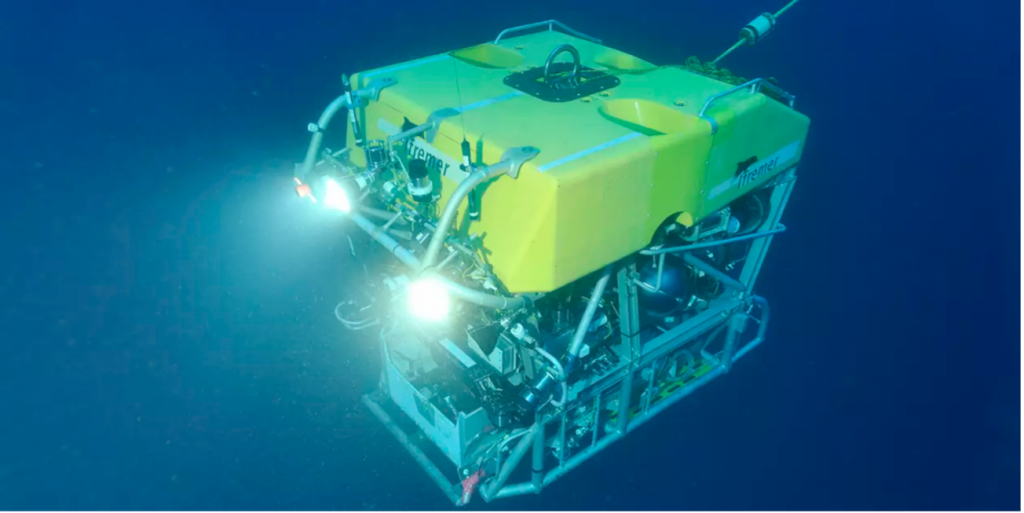
Underwater view from the Victor 6000 ROV ©️Ifremer, Olivier DUGORNAY
A new scale of observation and promising initial results
For his PhD thesis on the ‘Role of geological habitat heterogeneity in the spatial structuring of biodiversity on the seamounts of the Coral Sea Natural Park (New Caledonia) ”, supervised by Karine Olu (benthic ecologist at the BEEP Joint Research Unit) and Axel Ehrhold (sedimentologist at the Geo-Ocean Joint Research Unit), Félix is receiving full funding from the “Ocean and Climate” Priority Research Programme.
Thanks to the data collected during the KANADEEP 2 expedition, he is able to study the distribution of fauna across the entire seamount. By sifting through the thousands of photos captured by the ROV, he is particularly keen to highlight the incredible biological and geological diversity of these seamounts.
One question remains: how are these benthic species affected by the sometimes very powerful currents found on seamounts?
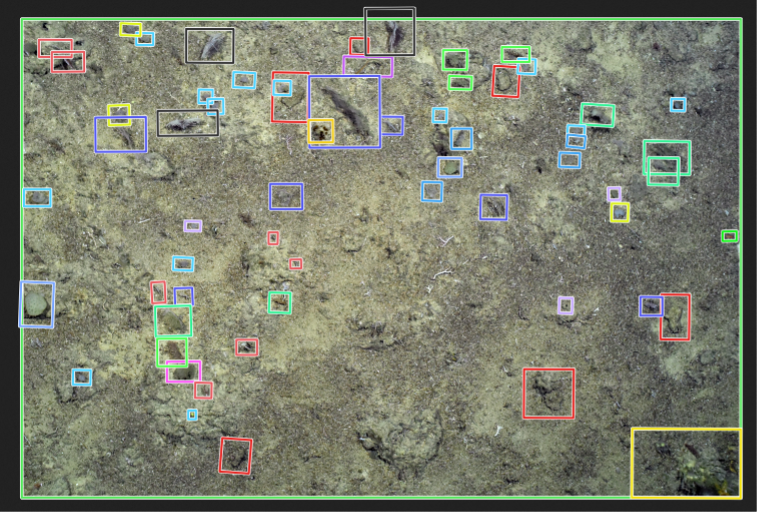
Image captured by the Victor 6000 ROV during the KANADEEP-2 campaign and annotated by Félix Navarro ©️F. Navarro
To answer this question and complete his study, Félix has teamed up with researchers from the Laboratory of Physical and Spatial Oceanography (LOPS, a joint CNRS-Ifremer-IRD-UBO research unit). Using numerical modelling of his study area, he aims to gain a better understanding of how underwater currents, and oceanographic conditions in general, influence the distribution of fauna and substrates on the seamounts.
After a year and a half of work, the initial results already show a strong relationship between the distribution of fauna and the geological and oceanographic environment of the seamounts, and are due to be published shortly.
Other questions remain to be answered, and the next chapter of the thesis will focus in particular on fine-scale details. Using various image analysis methods, Félix plans to reconstruct the seabed in 3D. High-resolution models (at a scale of a few centimetres) will enable him to better understand the distribution of species along the slopes of the seamounts and the nature of the seabed on which they live.
At the end of 2026, thanks to funding secured from the École Universitaire de Recherche , ISblue , and for an international mobility programme, Félix plans to spend two and a half months at Memorialof Newfoundland (St. John’s, Canada), where he will be able to collaborate with local experts specialising in this type of fine-scale research.
Three questions for Félix Navarro
Why did you decide to do a PhD in marine sciences?
Although my studies were more focused on terrestrial ecology, I have always been interested in marine sciences. I found marine ecosystems fascinating, and their organisation so similar yet so different from that of terrestrial ecosystems. Moreover, the vast majority of the marine world remains unknown. And it is, I think, this element of the unknown that drew me more and more towards marine sciences.
What made you want to apply for this thesis topic? What were your motivations?
Several things, I think. Firstly, I was intrigued by these seamounts, and then there was the interdisciplinary aspect, which I really enjoyed. I found the approach of simultaneously considering the benthic species of seamounts and the substrates on which they are found very interesting and meaningful. It was this interdisciplinary nature that motivated me the most.
How do you envisage your future after this PhD?
After my PhD, I’d like to continue in academic research. If possible, on seamounts. Numerous programmes to explore these structures are currently being set up in France and internationally, and I hope to join these programmes and continue exploring the functioning of these very unique ecosystems.
Reference: Félix Navarro, ‘The role of geological habitat heterogeneity in the spatial structuring of biodiversity on seamounts in the Coral Sea Natural Park (New Caledonia)’, PhD thesis 2024–2027
Contact:Felix.Navarro@ifremer.fr