

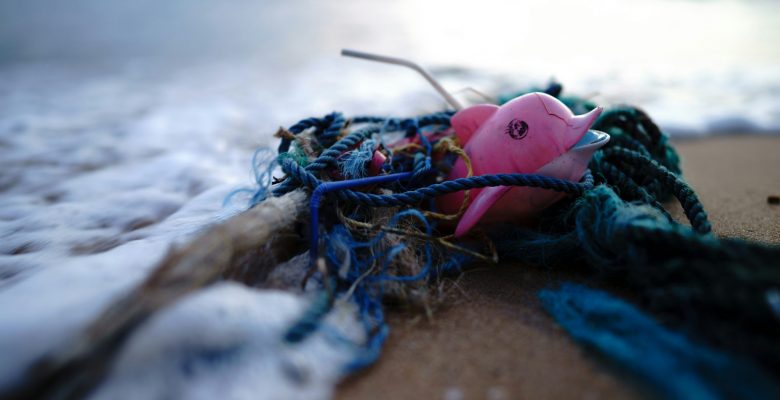
Faced with the proliferation of chemicals in the marine environment, the interdisciplinary PREVENT project, led by the Laboratory of Climate and Environmental Sciences (LSCE-IPSL) as part of the Priority Research Programme (PPR) ‘Ocean and Climate’, is experimenting with a new comprehensive approach to marine pollution. It is deploying significant resources to attempt to predict the combined impact of historical and emerging pollutants on marine organisms and ecosystems. The aim is to anticipate risks in the context of climate change and energy transition and to codevelop the regulations of tomorrow.
by Carole Saout-Grit
The ocean is no longer just our planet’s thermal regulator or the cradle of fascinating biodiversity. Over the decades, it has become the ultimate receptacle for contamination from our human activities.
While marine pollution has long been addressed in a segmented manner – plastic on one side, heavy metals on the other – modern science is attempting a new, more comprehensive approach. Just as human medicine studies the influence of the environment on our health, scientists are now looking at the oceanic ‘exposome’.
Launched in 2024 as part of the Priority Research Programme (PPR) Ocean and Climate and coordinated by the Laboratory of Climate and Environmental Sciences (LSCE-IPSL), the interdisciplinary project PREVENT (Predicting the Evolution and Biological Impact of the Ocean Exposome in the Context of Environmental Transition) is at the heart of this ambition.
From medicine to oceanography: the recent concept of the exposome
Although the term ‘exposome’, coined in 2005 by epidemiologist Christopher Wild, has its origins in medical research, it is now defined by France Exposome as ‘encompassing all exposures to environmental, i.e. non-genetic, factors that a human organism undergoes from conception to the end of life’.
Recently, this concept has been taken up by environmental scientists, particularly in oceanography, applying it to environmental and ocean pollution as a whole. In the natural environment, a fish or microalgae is simultaneously exposed to a multitude of toxic contaminants as well as additional stress factors, such as temperature variations due to climate change or water acidification.
The PREVENT project aims to decipher this combined, cumulative and synergistic effect of multiple pollutants in order to understand how this ‘cocktail’ affects marine life. Based on an innovative and highly collaborative scientific method, it brings together experts specialising in six fields of life and social sciences: marine biology and biogeochemistry, marine ecotoxicology, numerical modelling, political science, economics and environmental sociology.
Three priority targets: mercury, lithium and microplastics
To make this project operational, scientists are focusing on three types of pollutants: one historical pollutant and two emerging pollutants.
Mercury (Hg) is a historical pollutant that can pose serious risks to human health. Although it occurs naturally in the environment, recent anthropogenic emissions of mercury from several sources (including waste incinerators, mining, cement plants and the paper industry) have significantly altered its natural levels. Although regulated since 2013 by the Minamata Convention, it remains a major threat to marine ecosystems and human health due to its neurotoxic effects. In its organic form (methylmercury), it accumulates along the food chain, reaching toxic concentrations in large predators such as tuna and sharks. Many scientific questions remain about how these massive mercury emissions are transmitted to marine species and how climate change may influence this process.

Sample of the tuna base (photo credit: V. Allain)
Lithium (Li) is an emerging pollutant that is expected to become increasingly important in the coming decades due to the energy transition: achieving carbon neutrality by 2060 would lead to an increase in demand for lithium by more than two orders of magnitude, while only 1% of this trace metal is currently recycled. With the explosion in demand for electric vehicle batteries, lithium extraction and potential discharge are increasing, particularly in coastal areas. Its long-term effects on the physiology of marine organisms – particularly certain filter feeders such as plankton, which are at the base of the food web and capable of bioaccumulating lithium to a significant degree – are still poorly understood.
Finally, microplastics act as vectors for this cocktail of marine pollutants. Present everywhere, from the abyss to the ice floes, microplastics are not only a physical pollutant: they act as ‘sponges’ for pollutants, binding other chemicals and transporting them directly into the stomachs of organisms. The consequences of this emerging pollutant on ocean ecosystems are not yet fully understood, but it is likely to interact with the smallest organisms due to their very small size. The diversity of their physical and chemical properties makes their global distribution in the ocean difficult to predict and requires further research.
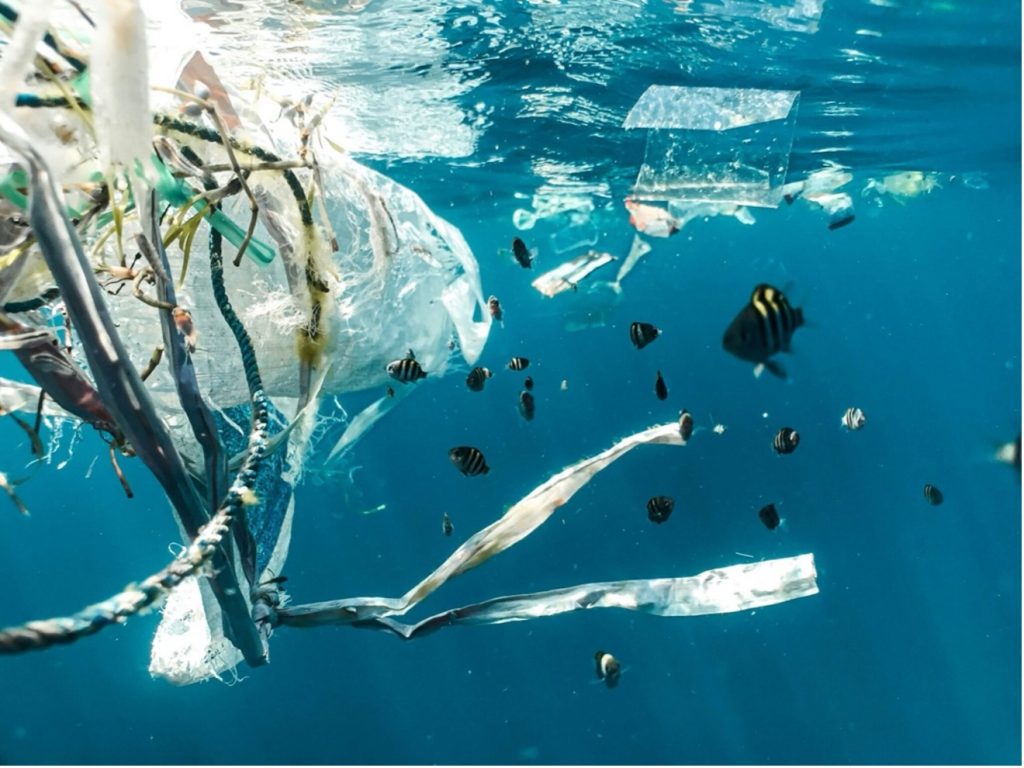
Plastics pollution in the ocean @pexels
An innovative multidisciplinary approach
To decipher the combined effects of marine pollutants and additional stress factors, particularly those linked to climate change and energy transition, the project employs a scientific method that is multidisciplinary, innovative and highly collaborative. In concrete terms, the project combines experimentation and modelling.
The experimental component focuses on understanding the dissemination and toxicity of these pollutants in marine ecosystems through in situ measurements in the ocean and laboratory measurements in mesocosms – devices holding several litres, enabling the fate of contaminants to be analysed in some ecosystems exposed to different controlled pollution conditions. The in situ measurements will be carried out in the bay of Villefranche-sur-Mer, at point B, which has been the LOV laboratory’s experimental site for decades and which, for the PREVENT project, will add pollutant measurements. The laboratory experiments will be conducted in mesocosms, available at the Villefranche Oceanography Laboratory and the MARBEC laboratory in Palavas-les-Flots. These results will provide a solid basis for modelling the relationships between environmental and ecological parameters and contamination in the marine system.
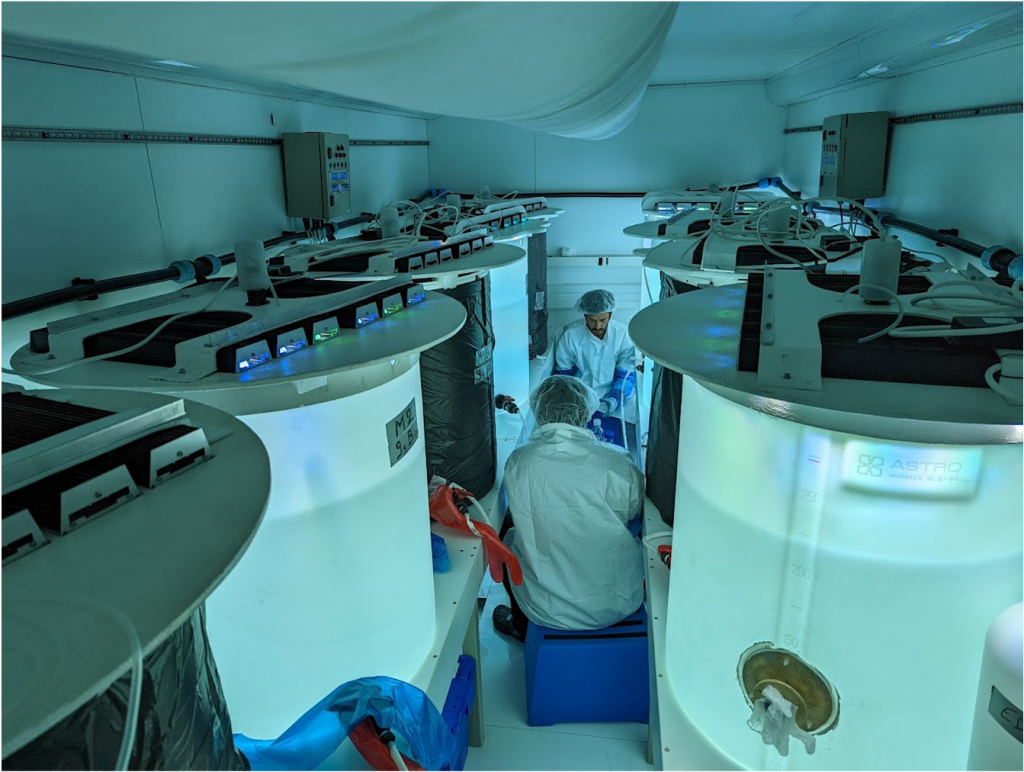
Experimental mesocosms at the Villefranche Oceanographic Laboratory @ LOV
Modelling is also a key part of the project. A new specific numerical model is being developed to simulate the spread and toxicity of pollutants in the oceans, from the water column to the food chain, from plankton reservoirs to fish. This model includes a physics module (NEMO), a marine biogeochemistry module (PISCES) and a food chain module (APECOSM). The three pollutants are integrated into this model to simulate their fate from the water column to fish.
This new model will then be used to make future projections of the impacts of pollutants on marine ecosystems in the context of global warming and energy transition. A summary of pollutant emission scenarios for 2050 will be drawn up on the basis of a literature review, and new scenarios will be proposed and studied, taking into account socio-planetary limits. Finally, a sociological survey and a more detailed analysis of plastic scenario narratives in the literature are underway to study the sociological impact of marine pollution.
Coconstructing with stakeholders
Making science a source of information that can be used in decision-making is an integral part of the PREVENT project. Thanks to the coordination between scientific and social science work, PREVENT is able to provide socio-economic scenarios and future trajectories, which are necessary to inform decision-making and the development of legislation.
The project plans to hold meetings with stakeholders (public administrations, NGO, industries…) through a PREVENT stakeholder forum. These exchanges should enable the coconstruction of scientific deliverables that meet the needs of decision-makers, while fostering a continuous link between academic research and stakeholders. A coordination team is specifically dedicated to facilitating this forum and developing communication tools.
A consortium of excellence
The PREVENT project is funded by France 2030 via the Agence Nationale de la Recherche (French National Research Agency). It is part of the 5th challenge of the Ocean and Climate PPR, which aims to develop understanding of the multiple stress factors that jointly affect marine organisms and ecosystems in order to protect them.
Coordinated by the CEA via the LSCE, it brings together six major partner institutions (IRD, Sorbonne University, CNRS, UVSQ and INRAE) and numerous laboratories as joint research units (MARBEC, LEMAR, LOPS, GET, LISIS,LOV, LOCEAN, CEARC). Additional collaboration is provided by the IAEA, especially for microplastic analysis. This joining of forces brings together numerous experts from several disciplines and links fundamental ocean sciences with economic and social sciences.
The challenge of PREVENT goes beyond simply measuring multiple forms of marine pollution and understanding their impact on marine ecosystems. The project aims to protect the ecosystem services provided by the ocean, ensuring that the ocean exposome does not become a death sentence for future generations.