

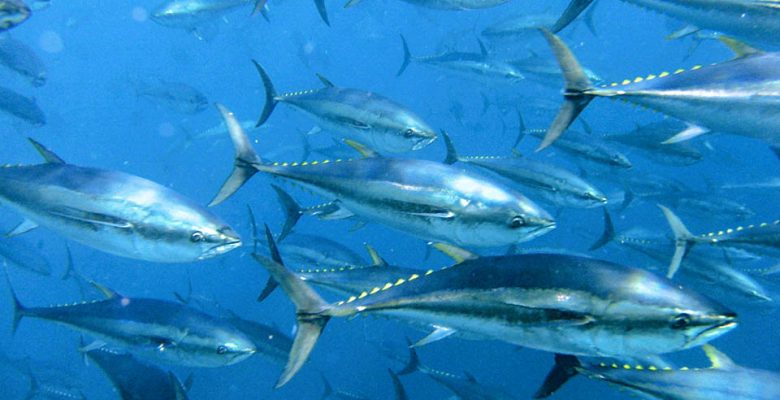
In a context of planetary limits and global tensions over health and food, much research is being conducted into fishery resources and their associated impacts. In particular, some scientists are studying longline fishing for bluefin tuna and its bycatch, which impacts the survival of other species of interest. Antoine Landreau, a doctoral student at the University of Montpellier as part of the Ocean and Climate Priority Research Programme, is testing an innovative and unique technological solution to better characterise these unexpected catches and reduce them.
By Carole Saout-Grit
Cover photo: Bluefin tunas(Thunnus thynnus) © Tom Puchner
What angler has never held a rod in their hand and experienced that moment of glory when a fish bites the hook and wriggles nervously as it comes out of the water? Now imagine you have the equivalent of several fishing rods, placed end to end at regular intervals along a main line, to which you attach lengths of nylon line, each ending in a hook. Then, perhaps without realising it, you have built a homemade longline, and all you have to do is choose the type of bait to put on each hook depending on the species you want to catch.
Antoine Landreau is one of those young fishermen who has been passionate about fish and angling since childhood. He even focused his studies on marine science and fisheries resource management, paving the way for his future career. Currently a doctoral student at the french Montpellier Laboratory of Computer Science, Robotics and Microelectronics (LIRMM), he is devoting three years of research to the effects of bycatch by longline fisheries in the Mediterranean and on Reunion Island.
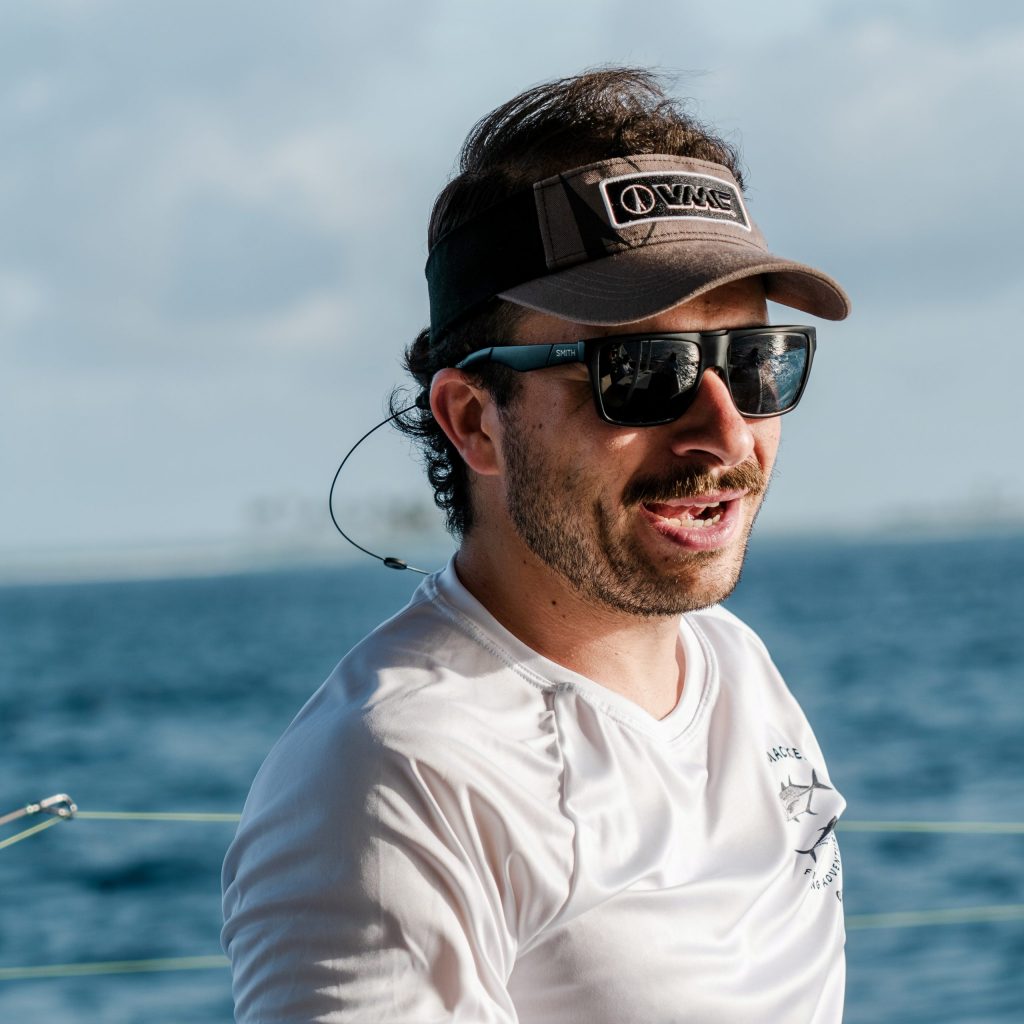
© Antoine Landreau
Longline fishing, a traditional and sustainable fishing method
Longlines are a traditional fishing method that developed in Japan in the 19th and early 20th centuries, before spreading widely across the Pacific Ocean in the 1930s. Depending on the species being fished, they can be weighted and anchored to the seabed or kept afloat by floats. Sharks, rays and whiting are caught using bottom longlines, while other species such as bluefin tuna, sea bass and swordfish are caught using drifting surface longlines.
Surface longline fishing (targeting bluefin tuna) is considered a traditional and sustainable fishing method. It limits negative effects on marine habitats, particularly the impact on the seabed, and the species brought on board are often of very good quality and generally alive.
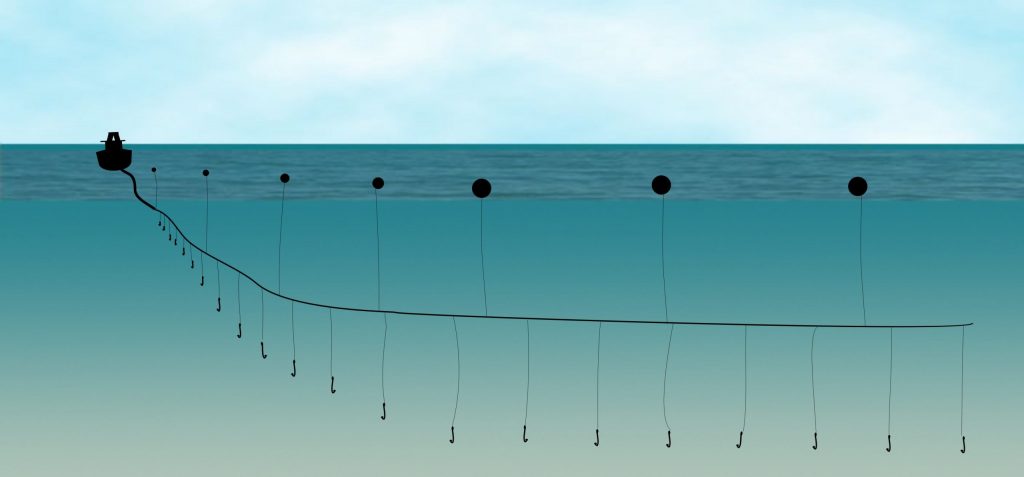
Diagram of floating Longline fishing technique © Ecomare/Oscar Bos CC BY-SA 4.0
However, longlines still generate bycatch: a swordfish longline, for example, can catch several species of tuna or shark; depending on the seas frequented, turtles may bite the hooks; and in certain conditions, seabirds attracted by the bait when the longline is set may also be caught.
Not to mention the massive use of bait, which can quickly make this fishing method expensive if catches are low.
Bluefin tuna in good health in the Mediterranean
Bluefin tuna is caught using rods or longlines by coastal vessels less than 18 metres in length, which fish on a daily basis in French waters in the Gulf of Lion in the Mediterranean and, further south, between the Spanish coast and the Balearic Islands. Although bluefin tuna can be fished all year round, the main season runs from March-April to November-December, when bluefin tuna move closer to the coast.
Severely overexploited in the 2000s, bluefin tuna stocks have recovered thanks to the joint efforts of scientists, governments, NGOs, fishermen and fisheries managers. After years of collective effort, in 2020, the Mediterranean longline fishery became the second MSC Sustainable Fishing certified fishery in the world for bluefin tuna, a certification that was renewed for the second time in November 2025, confirming the sustainability of its practices.
Although longline fisheries targeting bluefin tuna are considered selective, they still generate bycatch that threatens the survival of other species of interest. A guide to best practices has been developed to train fishermen in how to handle and release sensitive species such as blue shark and purple stingray, in order to maximise their chances of survival.
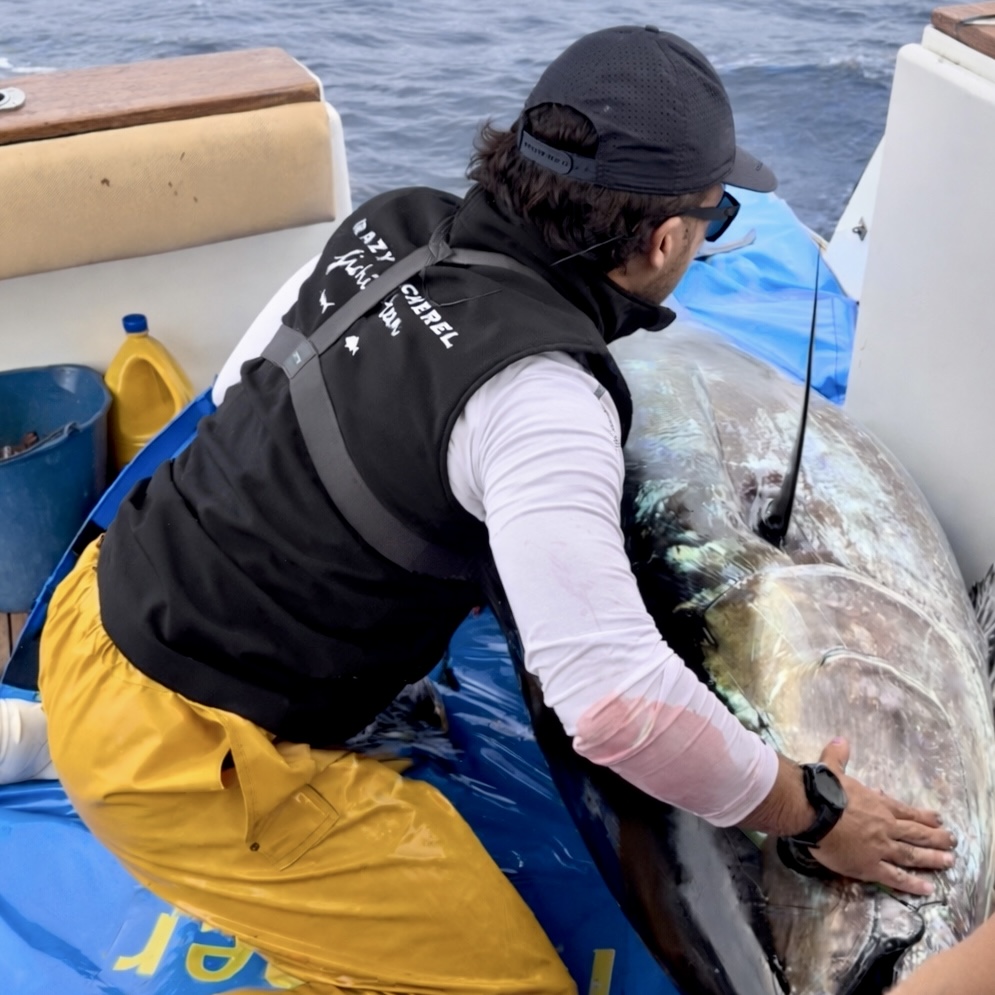
Antoine Landreau attaches an electronic sensor to a bluefin tuna.© Antoine Landreau
Innovation and technology serving marine species
Numerous scientific institutes (Ifremer, LIRMM, SATHOAN and COOOL SAS in particular) have been involved for several years in various multidisciplinary projects (RAYVIVAL, POBLEU, SMARTSNAP 1-2, LIFE EMM) on the subject of bycatch in longline fishing. In line with this, the thesis work carried out by Antoine Landreau and funded by the Ocean and Climate Priority Research Programme aims to provide an innovative and unique technological solution to better characterise these bycatches and propose possible solutions to reduce them.
Antoine is initially interested in characterising bycatch in two fisheries, one in the Mediterranean and the other in Réunion. For this first phase of species recognition, he identifies and differentiates the species caught incidentally on longlines, drawing on data already collected as part of the SMARTSNAP-1 project, as well as new data that he will collect during his thesis, particularly in collaboration with fishermen.
In a second phase, Antoine is developing and evaluating the ability of a new electronic device to discriminate between species caught on each hook based on their behaviour on the line, thus allowing bycatch to be released. This innovation, which takes the form of an electronic box placed near the hook, would maximise the survival of species caught incidentally on longlines and thus minimise the impact of fishing on these non-landed species. This device would operate in real time and hook by hook to recognise the species caught, communicate the information to the vessel and instantly release the animal if it does not correspond to the species targeted by the fisherman.
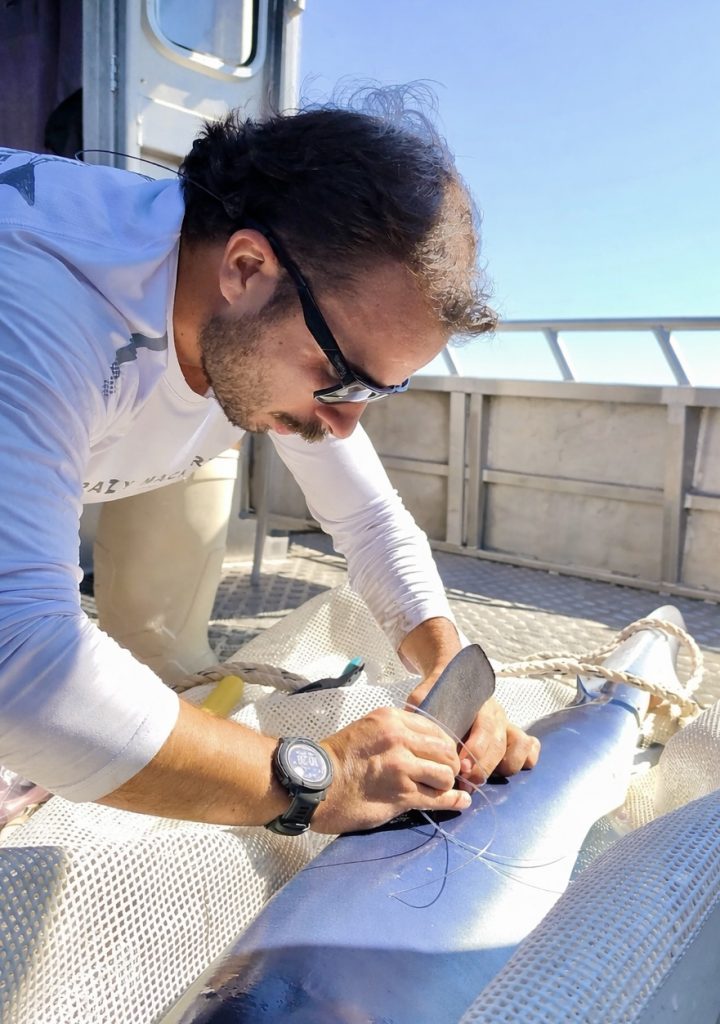
Antoine Landreau attaches an electronic sensor to a blue shark.© Antoine Landreau
Finally, in a last step, Antoine conducts new experiments using electronic tagging to analyse the survival of the different species caught and to assess the mortality associated with the release of by-catch. This electronic tagging began in the summer of 2025 and is set to continue in 2026-2027, particularly on bluefin tuna longlines in the Gulf of Lion.
While there is growing concern about certain sensitive and interesting species, such as the blue shark, Antoine’s thesis research should make it possible to estimate the survival of these animals released after being caught by longlines and to enrich our knowledge of the ecology of these often little-studied species.
Three questions to Antoine Landreau
Why did you want to do a thesis in marine science?
Ever since I was a child, I have been fascinated by the marine world, fish and fishing. I thought carefully about my future and focused my entire course of study on marine biology and marine sciences. After living abroad for six years in a place very close to the ocean, where I earned a bachelor’s and master’s degree in Marine Sciences and Fisheries Resource Management, I returned to France with the idea of pursuing a PhD. For me, it was the logical next step, allowing me to continue pursuing my passion while gaining more knowledge and experience and entering the scientific research sector.
What made you want to apply for this thesis topic? What were your motivations?
The subject and supervision. The subject, because it was essential for me that the thesis address issues surrounding the exploitation of fishery resources, and more specifically tuna. I didn’t want to choose a subject out of spite just for the sake of writing a thesis. I am fortunate to be guided and supported by Tristan Rouyer (who was my Master’s 2 internship supervisor), who conceived and wrote this topic with Vincent Kerzerho. It was important for me to stay with Tristan and repay the trust he had placed in me, while flourishing in my thesis on a subject that fascinates me. What’s more, this thesis project is completely innovative and unique, which is an additional source of motivation.
How do you imagine your future after this thesis?
I plan to continue working in the field of fisheries, and I want to remain involved in issues surrounding bluefin tuna and its exploitation, whether closely or from a distance. Whether I pursue postdoctoral studies will obviously depend on opportunities, but I will approach it in the same way as my thesis: if the subject remains within the scope of my passion, then I will apply. I have also recently become interested in the world of research coupled with teaching, with the aim of continuing to work on these topics but also passing on my knowledge and passion.
Reference : Antoine Landreau, «
Contribution to the characterisation and remediation of bycatch in two longline fisheries targeting large pelagic species in the Mediterranean Sea and the Indian Ocean », thesis 2024-2027
Contact : antoine.landreau@lirmm.fr