

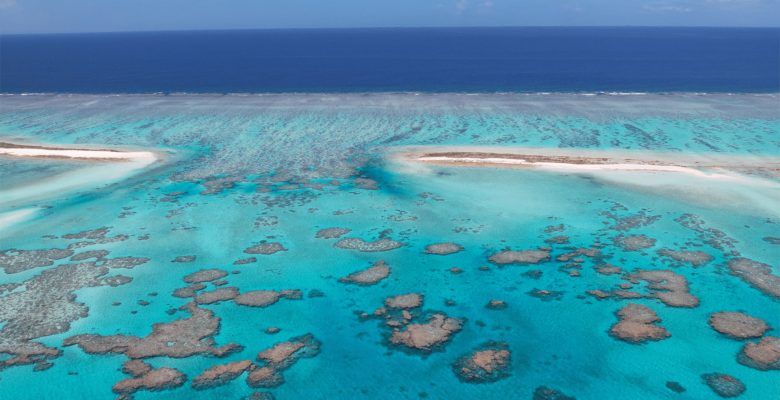
Faced with the intensification of marine heatwaves in the South Pacific, the MaHeWa project is mobilising researchers and local stakeholders in New Caledonia, French Polynesia and Wallis and Futuna. Launched in France in November 2024 as part of the french Priority Research Programme ‘Ocean & Climate’, the objective of this major scientific programme is to better understand the physical mechanisms at work during marine heatwave phenomena, to measure their ecological and social impacts, and to develop concrete tools to anticipate and mitigate the effects of these extreme events.
By Laurie Henry and Carole Saout-Grit
Cover photo : © IRD-M. Boussion
For several years now, just like heatwaves on land, the oceans have also been experiencing episodes of intense heat. Marine heatwaves, prolonged episodes during which ocean temperatures remain abnormally high for several days, disrupt physical and biological balances, causing coral bleaching, the death of coastal species, the proliferation of toxic algae, and other effects, with sometimes disastrous socio-economic consequences for certain sectors such as fishing and tourism.
But although this extreme ocean phenomenon is now increasingly observed, it remains poorly documented and poorly understood in its entirety. Funded by the french France2030 programme and the French National Research Agency (ANR) for four years over the period 2024-2028, the MaHeWa (Marine HeatWaves) project is led by the Research Institute for Development (IRD) alongside Ifremer, the CNRS, the Louis Malardé Institute (ILM), local and metropolitan universities, Météo-France and overseas partners. It combines fundamental science, applied methods and concrete actions in the field to try to better understand and anticipate the risks posed by marine heatwaves to Pacific island territories. And its first results are already very real: diagnoses made on the conditions for the occurrence of these marine heatwaves, ecological monitoring, instrumentation campaigns and the concrete co-construction of decision-making tools.
An integrated scientific architecture for a systemic challenge
The MaHeWa scientific programme is based on a clear methodological structure that interconnects various components specific to marine heatwaves, namely:
- Exposure to thermal stress, through specific analysis of the physical characteristics of ocean heat waves, their origin and evolution
- Biological impacts, through the study of coral mortality, the vulnerability of exploited species (aquaculture or small-scale fisheries), and certain toxic algal blooms and the associated risk of ciguatera poisoning
- Socio-economic vulnerability, through the assessment of island societies’ dependence on marine ecosystems and the study of community resilience strategies in the face of marine heatwaves
The co-construction of decision-making tools adapted to local contexts and a field testing phase for pilot solutions are also part of the cross-cutting and transdisciplinary actions carried out in conjunction with local managers and populations.
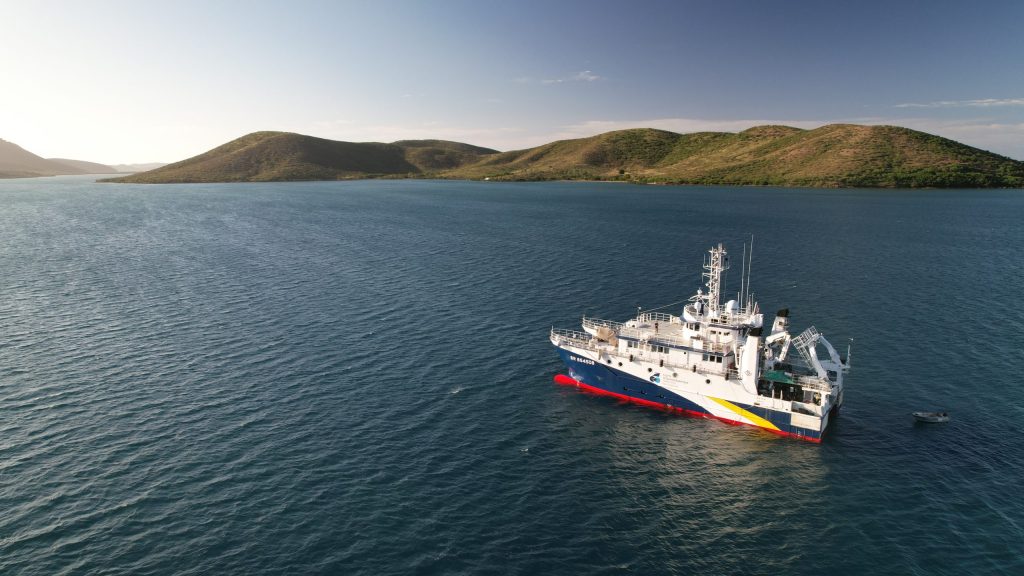
From 20 to 29 March 2025, the ship ANTEA docked at Lifou, in the Loyalty Islands subdivision of New Caledonia @IRD-M. Boussion
This cross-disciplinary organisation of the programme into thematic modules allows for interdisciplinary collaboration. Data on exposure to thermal risk feeds into biological experiments, while social observations inform the development of decision-making tools and the co-construction of pilot solutions. An additional unit plays a central role in overall integration and co-construction through transdisciplinary approaches, involving local authorities, government departments, traditional communities and other associations from the outset of the project.
Thanks to this organisation, measurement campaigns have been launched alongside social surveys and participatory workshops, ensuring greater efficiency in the development of tools designed to be useful, usable and used. MaHeWa’s modular approach thus embodies a new way of doing science: action-oriented, rooted in the territories and attentive to the complexity of the issues at stake.
Exceptional marine heatwaves in the tropical Pacific
The analysis of exposure to thermal stress is a key component of the MaHeWa project. Researchers observe the frequency, intensity, duration and spatial distribution of past and projected marine heatwaves. These analyses are based on satellite data, in situ measurements and detailed climate modelling. Researchers have thus demonstrated the key role of climate variability modes (such as ENSO, El Niño Southern Oscillation) in triggering marine heatwaves. They are also interested in high-frequency phenomena, such as ocean tides, which alter temperatures near the coast and can bring welcome cooling.
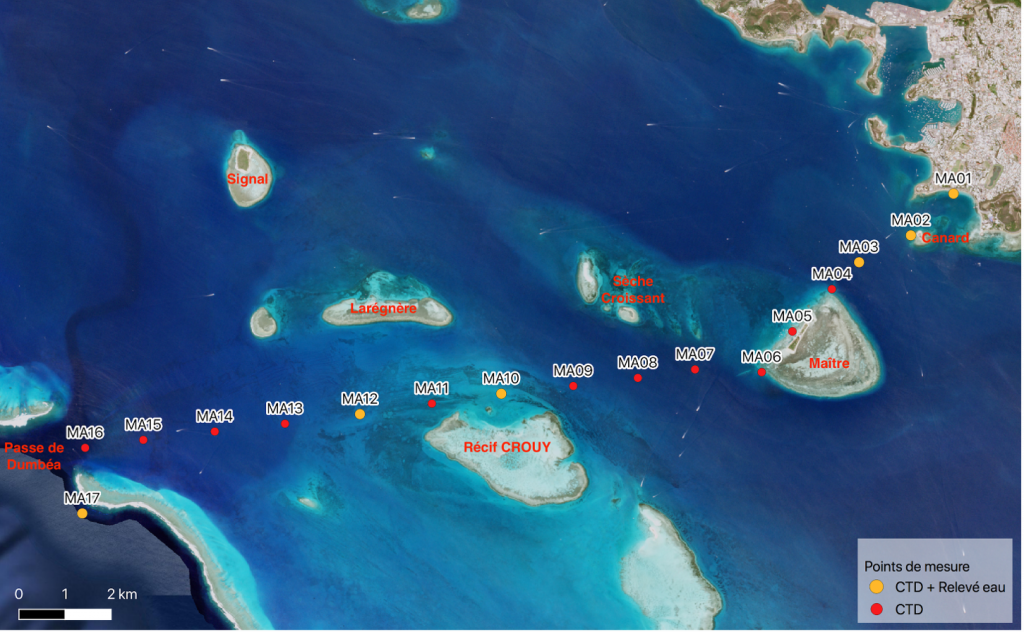
Monthly monitoring in the Nouméa lagoon @ R. Le Gendre, Ifremer
The teams involved are also studying the specific characteristics of each lagoon, with instrumentation campaigns and regular monitoring. Their morphology, degree of isolation and depth influence the capacity of the waters to warm up or renew themselves. For example, a shallow lagoon such as Takapoto may be more vulnerable to a prolonged heatwave than a more open lagoon such as Mangareva.
The identification of areas at high thermal risk directly feeds into other aspects of the programme. It enables the targeting of locations for biological experiments and social surveys, but also alerts local stakeholders to areas where ecological monitoring needs to be stepped up. This fundamental work of dynamic mapping will serve as the basis for early warning systems. The approach adopted is evolutionary: the maps are updated as the data is refined.
Measurable biological impacts and significant human health concerns
The biological effects of marine heatwaves are a second pillar of the programme. Scientific teams are assessing how marine organisms, particularly certain key species such as reef-building corals, lagoon fish, algae and certain bivalves such as giant clams and pearl oysters, respond to thermal stress.
Researchers are conducting experiments in controlled aquariums and field monitoring on several islands. Prolonged exposure tests are used to determine lethal thresholds.
At the same time, genetic studies are being conducted to identify markers of thermal tolerance. The aim is to detect the most resistant strains in order to develop improved restoration strategies. This research is being carried out in conjunction with the coral farm project in Lifou and with local aquaculture centres, particularly in Polynesia, where pearl farming is crucial to the economy.
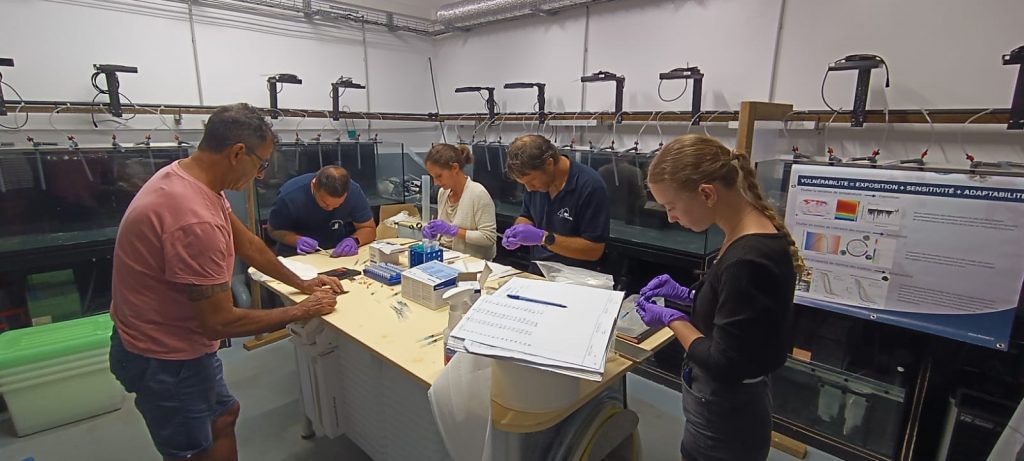
Vairao (Tahiti), november 2025 – The MaHeWa project has reached an important milestone with the completion of the first experimental simulation of marine heatwaves applied to the sunfish Platax orbicularis, or Paraha peue. This species, emblematic of Polynesian lagoons and of aquaculture interest for the fenua, was the subject of an experimental protocol designed and implemented during the mission of Benjamin Geffroy (Ifremer – UMR MARBEC Montpellier), who came to support the Ifremer team in Vairao in preparing the equipment and launching the trials.. © C. Di Poi, Ifremer
Another sensitive issue is the proliferation of toxic microalgae. Heat waves promote their growth, increasing the risk of human poisoning, such as ciguatera. Observations carried out in the Wallis and Futuna archipelagos reveal an increase in risk areas. The crisis biology mobilised by MaHeWa thus makes it possible to anticipate ecological disruptions and informs certain adaptation solutions, such as the choice of thermotolerant species or the modification of aquaculture practices.
Social vulnerabilities and adaptation of island territories
The third part of the project explores the vulnerability of island societies to marine heatwaves. In French Polynesia, New Caledonia and Wallis and Futuna, local economies such as small-scale fishing, aquaculture, tourism and traditional medicine are heavily dependent on the health of marine ecosystems.
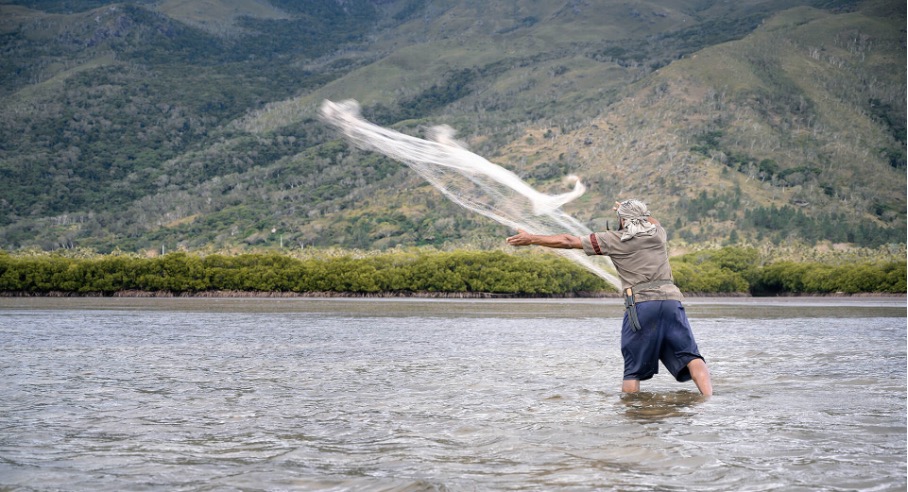
Ethnographic surveys and participatory workshops have been launched with local communities. They reveal a growing awareness of climate change, but little specific knowledge of the phenomenon of marine heatwaves. Some communities have noticed an increase in diseases linked to the consumption of contaminated fish or the scarcity of certain species.
© IRD- P. Dumas
Researchers also analyse ‘risk cultures’, i.e. the different ways in which societies anticipate, interpret and respond to extreme events. This diversity of attitudes to risk has a strong influence on the adaptation scenarios envisaged. Territorialised diagnoses also include specific socio-economic indicators: level of dependence on coastal resources, access to information, logistical resources, and local governance. This data is cross-referenced with thermal exposure maps and biological results, creating an integrated approach.
Developing decision-making tools and testing solutions
The final phase of the research conducted as part of MaHeWa concerns the transformation of scientific knowledge into concrete tools that can be used locally. Since its inception, the project has brought together managers, elected officials, public services and communities to jointly develop solutions. This shared governance is essential to ensure that the results are taken on board.
Among the tools under development are short-term warning systems to signal an imminent marine heatwave. These alerts, developed in close collaboration with the Mercator-Ocean and Météo-France operational centres, will eventually include critical temperature thresholds for local ecosystems and will be integrated into existing environmental monitoring systems, in partnership with health agencies and authorities. At the same time, bio-cultural vulnerability maps will be designed to cross-reference physical exposure, ecological fragilities and social dependencies in order to guide priorities for action. These maps will be used to develop management plans tailored to each territory.
Finally, the project will test “nature-based solutions”. In Lifou, MaHeWa will work closely with the coral farm project to help optimise coral restoration with thermotolerant corals. In aquaculture, avenues are being explored to diversify the species farmed according to their thermal robustness; the project will also test innovative nature-based solutions to combat habitat degradation. Finally, the MaHeWa project relies on a broad awareness-raising strategy to disseminate the knowledge produced through a variety of media and gradually roll out educational workshops, artistic creations and local radio stations.